
I’ve Been Chewing This Over: Dermatophagia, Midlife and the Power of Noticing
I’ve been chewing this over for most of my life although, if I’m honest, I’m far more of a nibbler than a chewer.
It’s something I’ve done for as long as I can remember. I nibble tiny pieces of skin from the inside of my mouth, usually while I’m concentrating, thinking or completely absorbed in something else.
My symptoms are gentle. I don’t cause ulcers or serious damage, but I can spend an extraordinary amount of time performing what can only be described as face gymnastics, stretching my cheek with the help of a finger, or contorting my mouth to reach that one tiny piece of skin I have decided must be found and nibbled.
It’s rarely something I notice while I’m doing it.
Usually, an off-guard photograph catches me making one of those familiar little expressions. Or I glimpse myself in the mirror and realise what my mouth has been quietly getting up to.
Strangely, you won’t often see it in my content. I’m far too aware of what my mouth is doing when the camera is deliberately turned on. He he. Always and forever, unapologetically Mala.
For years, I simply called it a Mala-ism: a habit I couldn’t control and didn’t think I needed to address or think too much about.
But lately, with my Mirror Time Method™ in mind, I’ve been asking myself some gentle questions about the things I notice that I do.
Can I control it, or can’t I? Or have I simply never been ready to let go of something that may have brought me comfort?
A name, but not necessarily a diagnosis
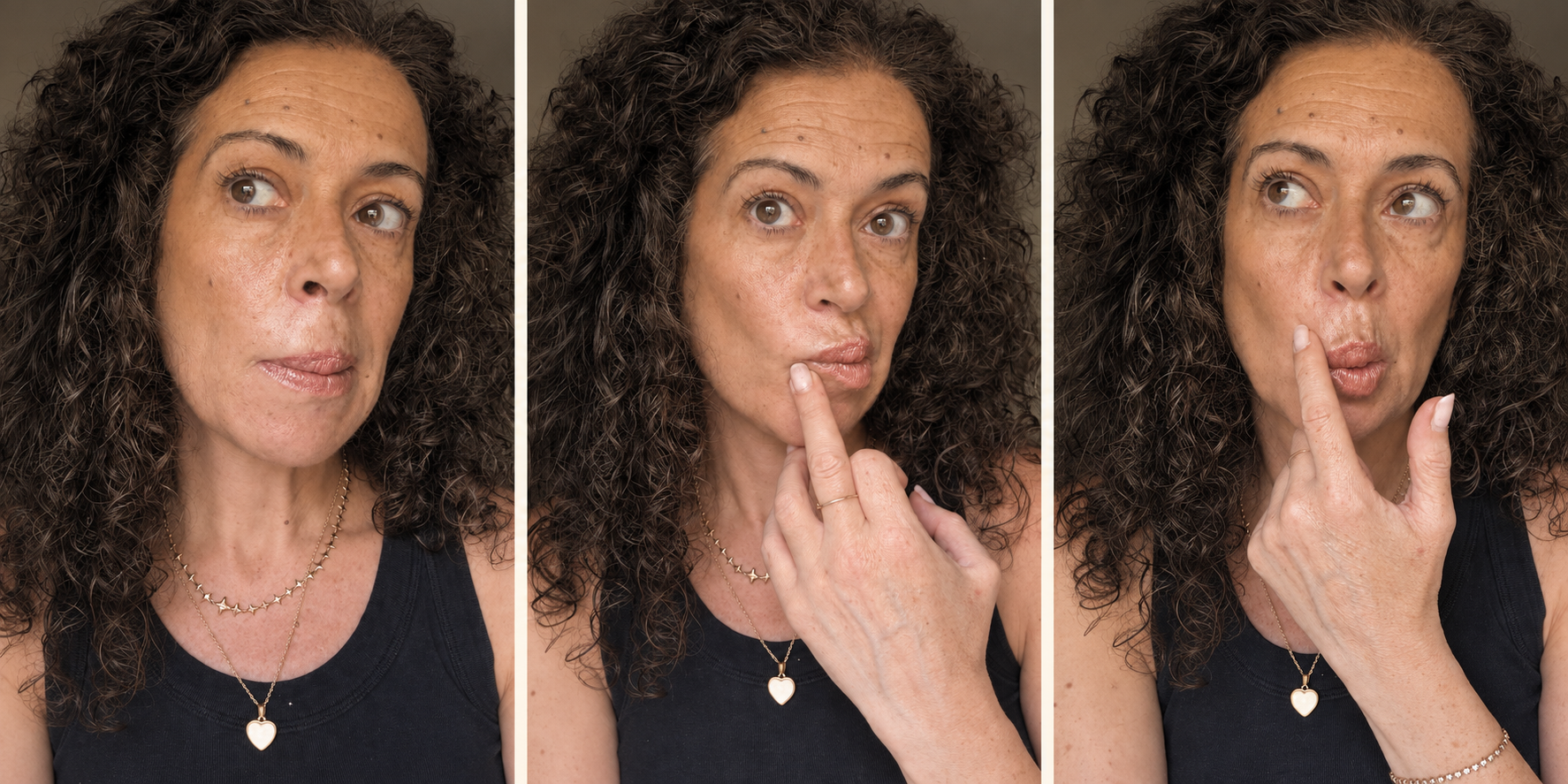
Mala Moonbeam demonstrating mouth and cheek movements associated with Dermatophagia and biting the inside of the mouth.
After sharing my original Instagram post, many of you wrote to me with your own experiences, questions and information. A huge thank you to British makeup artist Sam Chapman, known for Pixiwoo and as a co-creator of Real Techniques, who shared her story with such honesty and gave this habit its all-important name for me:
Dermatophagia.
Dermatophagia describes repeated biting or nibbling of the skin. It can be conscious or completely unconscious and is often discussed alongside body-focused repetitive behaviours, sometimes shortened to BFRBs.
Mine appears to be a self-soother of sorts.
Perhaps it gives nervous energy somewhere to settle. Perhaps it helps me concentrate or hold on to a thought. Perhaps my body discovered a long time ago that this tiny action helped me feel safe, and simply kept remembering.
I have, naturally, spent time disappearing down the proverbial rabbit hole. There is also discussion around these repetitive behaviours occurring alongside anxiety, stress or neurodivergence for some people.
That association is not a diagnosis, and it certainly doesn’t mean that everyone who nibbles their skin is neurodivergent. It is simply another possible piece of information, something we may choose to explore further or merely place gently on the shelf marked, “Well, that’s interesting.”
And that distinction matters to me.
The comment that opened the conversation
In her thoughtful comment beneath my post, Sam described living with Dermatophagia throughout her life, including unconsciously biting her tongue, cheeks, lips, fingers and knuckles.
She ended with something beautifully short and honest:
“It made a lot more sense when I was diagnosed. I’m not so hard on myself about it now.”
Thank you, Sam, for lending such candour to a conversation that helped many of us feel seen.
That stayed with me.
Not because it made me think that everybody needs to pursue a diagnosis, but because understanding brought Sam greater compassion for herself.
For one woman, clarity may come through diagnosis. For another, it may come through a conversation. For someone else, simply discovering that a behaviour has a name, and that she isn’t the only person doing it, may provide enough understanding for now.
There is no single correct response.
One woman commented that stress caused her unconscious behaviours to return, but that she was noticing and trying to be gentle with herself.
Another said, “This is me too.”
Someone else had been doing it since childhood and had never realised it was “a thing.”
That is why honest conversations matter. They turn private peculiarities into shared humanity.
They allow another woman to exhale and say:
“Oh. I do that too.”
Midlife is a season of discovery
I believe midlife is full of discovery.
Discovering yourself. Deciding what you would like to understand more deeply. Choosing which rabbit holes are useful, and which ones you can climb back out of without needing an immediate answer.
Sometimes discovery leads to professional support or diagnosis.
Sometimes it leads to change.
Sometimes it leads only to awareness, and that can be valuable too.
At this stage, I’m not looking to diagnose myself. I’m noticing one of many things about the way my body and mind have learned to move through the world.
I can look towards its roots. I can wonder where it began and what purpose it may have served. I can notice whether it appears more often when I’m anxious, concentrating or trying to hold too many thoughts at once.
And then I can decide what, if anything, I need today.
That decision may change tomorrow.
That is my kind of mindfulness.
It is not insisting that every behaviour must immediately be fixed, explained or removed. It is learning to look, see and notice without judgement.
Where Mirror Time begins
This is where my Mirror Time Method™ becomes more than a beauty ritual.
The mirror gives me a place to notice rather than judge.
When I catch my mouth beginning its familiar gymnastics, I don’t need to scold myself or demand that I “just stop.” I can use my reflection as a gentle invitation to pause.
To breathe.
To notice what I’m feeling.
To ask what my body might be trying to regulate or soothe.
To come back into balance or, as I often think of it, to equalise.
I want to feel equal within myself: grounded, calm and balanced enough to hear my intuition and make a decision that feels whole and right for me in that moment.
Mirror Time Method™ uses moments we already have at the mirror to help us pause, regulate, listen and reconnect.
It is not about staring at yourself and searching for faults.
It is about meeting your own eyes and asking:
What do I notice? What might I need? What feels right for me today?
For me, beauty has always been the doorway. But what waits on the other side is self-connection.
Awareness, acceptance or action?
I am not suggesting that awareness must always be the end of the story.
If a repetitive behaviour is causing pain, broken skin, infection, dental problems, distress or disruption to daily life, speaking to a GP, dentist or qualified mental health professional would be a loving and sensible next step.
Wanting help is not failure.
Wanting a diagnosis is not overreacting.
Equally, noticing a gentle behaviour and deciding that you do not need to investigate it further right now is not avoidance.
We are allowed to choose what support looks like for us.
For the moment, I know. I notice. I’m aware.
And awareness has softened the way I speak to myself about it.
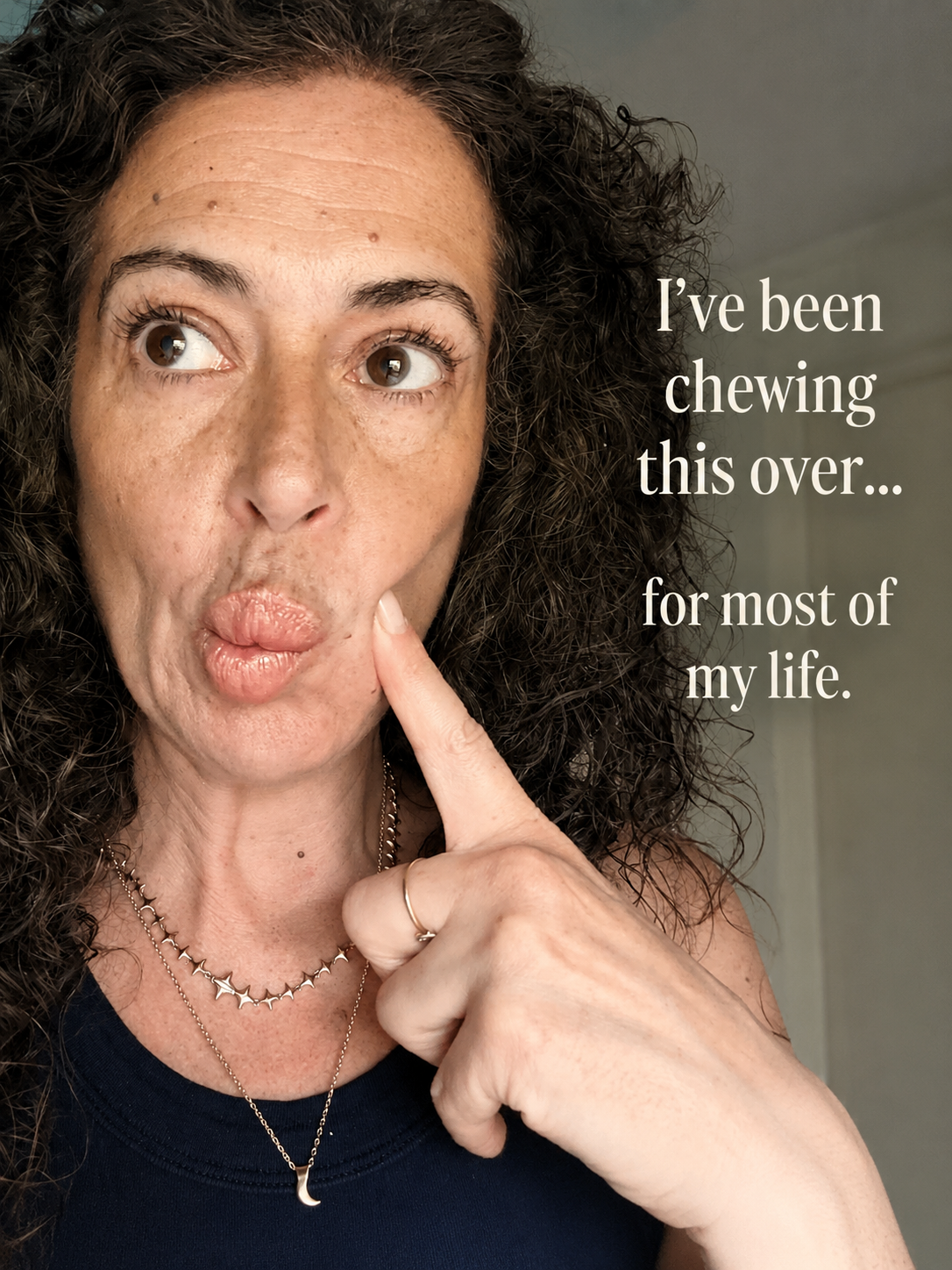
Three portraits of Mala Moonbeam showing unconscious facial contortions linked to cheek biting, a body-focused repetitive behaviour.
Perhaps that is the quiet gift in all of this: not another reason to find fault with ourselves, but another opportunity to understand the clever, complicated ways our bodies have tried to comfort us.
Midlife keeps inviting us to discover who we are beneath the habits, expectations and old stories.
We can seek answers.
We can seek acceptance.
We can change our minds tomorrow.
And no one route is right for every woman.
So I would love to know:
Do you have a little habit that your body seems to remember, even when you don’t? Would understanding or diagnosis bring you comfort or, for now, are you happy simply to notice that it is there?
Love,
Mala Moonbeam📿
This is my personal experience and is not a diagnosis or medical advice. If a body-focused behaviour is causing injury, pain, distress or interfering with your life, please seek guidance from an appropriate healthcare professional.